Genomics pave the way for future success

Breeding from the best is key to a building a herd of profitable and productive cows. And genomic testing has a vital role to play in allowing informed selection choices to be made.
Each cow counts at Marsh Farm, and Joe Welford, with his father Andrew, looks to breed productive and profitable cows that have the potential to do well on their system.
The Welford family from Scaling, just four miles from Saltburn, on the East Coast, have come a long way since Joe’s great grandfather took on the tenanted 60-hectare dairy unit in 1944.
Since then, the family has taken on more land and expanded, and in 2020 Joe and his father had the opportunity to buy the farm. Now they run 320 Holstein cows and 160 followers on 162-hectares of mainly grassland with a small amount of cereals grown for the dairy ration, rotated with grassland reseeding.
The herd is run by Joe, who does all the milking, Andrew, full time herdsman Roger Wilkinson, and part time help.
Cows are milked twice a day, and yields are currently 10,500kg of milk at 4.6% fat and 3.5% protein. Milk is sold to Arla on the Arla Care scheme.
“We’re a fairly intensive system and fully committed to dairy,” says Joe, who adds that joining Arla Care in 2021 formalised much of what they were already doing and achieving but gave them benchmarks and encouraged progress.
“For example, we carry out an annual individual cow Johne’s screen across the herd through NMR’s HerdWise service using the milk sample collected for quality testing.
“We’ve been completely closed for 30 years and we’ve no symptoms of Johne’s at all. This annual test meets our Arla Care requirements and confirms our almost negligible infection rates. But if any cows did show Johne’s infection, the testing frequency would be increased.”
NMR milk recording, done monthly, keeps tabs on somatic cell count too, which currently averages 120,000 cells/ml. “We get results back in 24 hours so I can pick up any problems and see how the cows are doing almost in real-time.”
Problem-free

But the ethos on this farm isn’t for solving problems in the herd. The key driver for Joe is to improve the efficiency and profitability of each cow by breeding healthy, long lasting and productive animals.
“I don’t want to achieve the same milk sales from more cows or fill the tank at any cost, but I want each cow to produce high quality milk as efficiently as possible,” he says, adding that this was the driver behind him starting genomic testing of heifer calves in 2020.
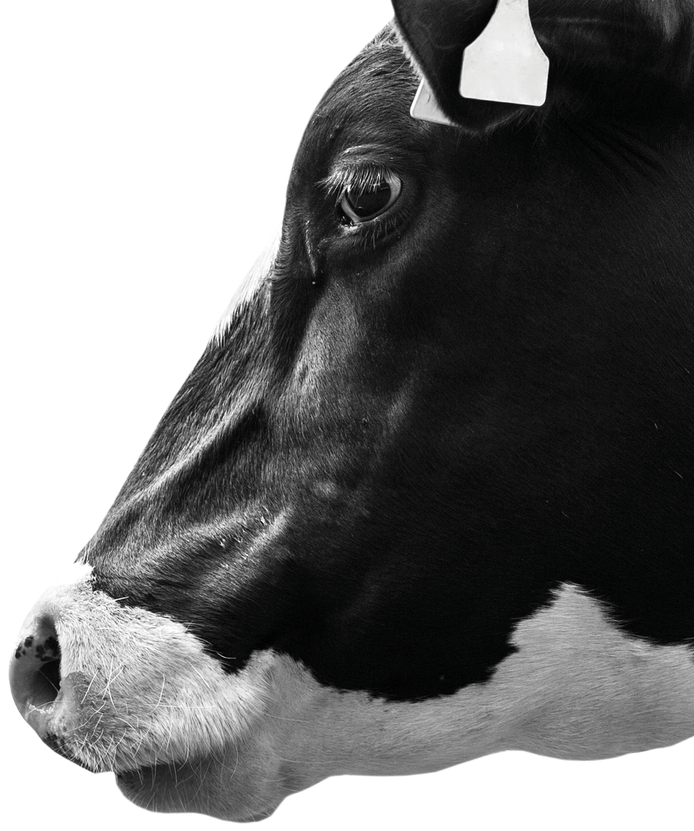
They use NMR’s tag and test to take an ear tissue sample for genomic testing of heifer calves at three weeks old. The DNA blueprint for each young calf is processed and reported through Zoetis’ Clarifide service to provide a dairy, wellness and profit index (DWP) for each animal.
Balance
“It’s an ideal index for me,” he says. “It’s weighted to producing a healthy and fertile cow with a good leaning towards fat and protein, which is what we’re paid for.
“While we’re keen to keep increasing production, we need to breed healthy and fertility cows to be profitable. It’s a balance.”
“Our selection cut off for heifers to breed replacements from was a DWP index of 600 in 2018, now its 700 – that’s good progress,” he adds.
“Milk yields and quality have gradually increased in the past four years but so have health traits and fertility. Genomic data has been key to identifying the best heifers and speeding up breeding a healthier, more productive and efficient cow that works well on our system, which is what we’re aiming for.
“Also, in my mind, genomics is just as much about deselection and not breeding from heifers and young cows that don’t make the cut.”
Animals not assigned to a dairy sire are breed to Wagyu beef sires and leave the farm at three weeks old for a rearing unit. “This works well for us as the sires are easy calving.”
He considers genomic testing a long term investment. “And if you want to breed replacements from your best animals and you’re using sexed semen and can manage the system, the £30 genomic test is very worthwhile.
Joe looks for 75 replacement heifers each year. He earmarks three or four possible sires, which is narrowed down via the Genus mating program.

“I’m fussy. I look at PLI, and want sires noted for good fat and protein as well as high values on traits that support improved feed efficiency, longevity and can support environmental criteria. Future generations should be more efficient, and this, for me, is a slightly smaller cow too.”
Fertility in this all year-round calving herd is important and through using the DWP index, which has a 17% weighting on fertility, the herd is improving. The current calving interval is 390 days with 2.08 services per conception and a pregnancy rate to first service around 50%.
“We do our own AI,” says Joe, adding that his vet wife, Wendy, does the weekly PD testing between looking after the couple’s young family.
The Welfords have never been averse to new technology that advances and future-proofs their business and supports cow performance.
In 2008 a wind turbine was installed on the farm to provide 10kw of energy and more recently solar panels can supply up to 130kw of energy. Joe is keen to make even better use of these renewable energy sources perhaps with battery storage when the time – and cost – is right.
In 2024 they invested in a 40:40 herringbone parlour with GEA software to record yields and alter feed rates. “This reduced milking times by three and a half hours a day,” says Joe, who does all the milking and admits that technology that can ease the pressure on labour, which is a limiting factor on many dairy unts, is an important consideration.
“We’ve also invested in cow collars to improve heat detection, and a robot to scrape out the sheds. Cow comfort has been improved with cubicle mattresses and flexible bars, and cow brushes strategically positioned in the shed, are in almost constant use through the day.
Cows are fed a TMR comprising grass silage, pressed pulp, biscuit waste, and a blend formulated by I’Anson, who also supply parlour cake which is fed to yield.
Currently, a third of the milking herd is genomically tested and the average PLI of the most recently genomically tested heifers double that of third lactation cows.
“We’re feeding and managing cows with far more potential,” says Joe. “Genomics is working well and building a herd of cows for the future. Our challenge is to manage these cows, so we can reap the benefits.”